Table of Contents
#1 on Frontend Code Arena. Dead last on Humanity's Last Exam compared to Fable 5. Pricing 4× higher than leaked.
Kimi K3 launched on July 16, 2026, and within 24 hours the benchmark screenshots were everywhere — except most of them only showed the scores Moonshot wanted you to see.
If you have been scrolling through X posts trying to figure out whether K3 is actually better than GPT-5.6 or Fable 5, you already know the problem: every post cherry-picks a different number. One says "best open model ever." Another says "still behind Opus on reasoning." Both are technically correct — they are just looking at different benchmarks.
This article puts every published Kimi K3 benchmark score in one place, head-to-head against GPT-5.6 Sol, Claude Fable 5, Claude Opus 4.8, and GLM-5.2. We pulled data from BenchLM's model tracker, Artificial Analysis composite indexes, the Arena.ai leaderboard, and Moonshot's official release table — cross-referenced across sources, with discrepancies noted. By the end, you will know exactly which tasks K3 leads on, which it loses, and whether the pricing makes it worth switching. Updated as new independent evaluations arrive.
Quick Reference: Kimi K3 at a Glance
Before diving into individual benchmarks, here are the confirmed specs — several differ from the pre-release leaks:
| Spec | Pre-Release Leak | Official (July 16) |
|---|---|---|
| Total parameters | ~2.5T | 2.8T |
| Architecture | MoE + Kimi-Linear | MoE, 896 experts, 16 active per token |
| Attention mechanism | Kimi-Linear | Kimi Delta Attention (KDA) — evolved hybrid linear attention |
| Context window | 1M tokens | 1M tokens (confirmed) |
| Input modalities | Conflicting reports | Text, image, video (multimodal confirmed) |
| Pricing (input/1M tokens) | ~$0.80–1.20 | $3.00 (cache miss), $0.30 (cache hit) |
| Pricing (output/1M tokens) | ~$3.50–4.50 | $15.00 |
| Open weights | "Expected" | Scheduled July 27, 2026 |
The parameter count jumped from 2.5T to 2.8T. Multimodal was confirmed. But the biggest surprise is pricing: the actual rates are 3–4× higher than leaked estimates. More on that below.
Expert pitfall: "16 of 896 experts" means less compute than the headline suggests. K3 routes each token through only 16 of its 896 expert modules. The active parameter count per token — the part that determines single-query reasoning power — is a small fraction of 2.8T. This is typical MoE design, but it means "2.8 trillion parameter model" is not comparable to a hypothetical 2.8T dense model. If someone tells you K3 has "2.8 trillion parameters of intelligence," they are confusing total capacity with per-token compute.
The specs set the stage. Now let us see whether the benchmarks justify the architecture.
Coding Benchmarks: K3 Wins Endurance, Loses Depth
Coding is Kimi K3's strongest category overall. It leads on two benchmarks, ties on one, and trails on two.
| Benchmark | Kimi K3 | Fable 5 | GPT-5.6 Sol | Opus 4.8 | GPT-5.5 | GLM-5.2 |
|---|---|---|---|---|---|---|
| SWE-bench Verified | 76.8% | — | — | — | — | — |
| DeepSWE | 67.5 | 70.0 | 73.0 | 59.0 | 67.0 | 46.2 |
| FrontierSWE | 81.2 | 86.6 | 71.3 | 66.7 | 64.9 | 67.3 |
| Terminal-Bench 2.1 | 88.3 | 84.6 | 88.8 | 84.6 | 83.4 | 82.7 |
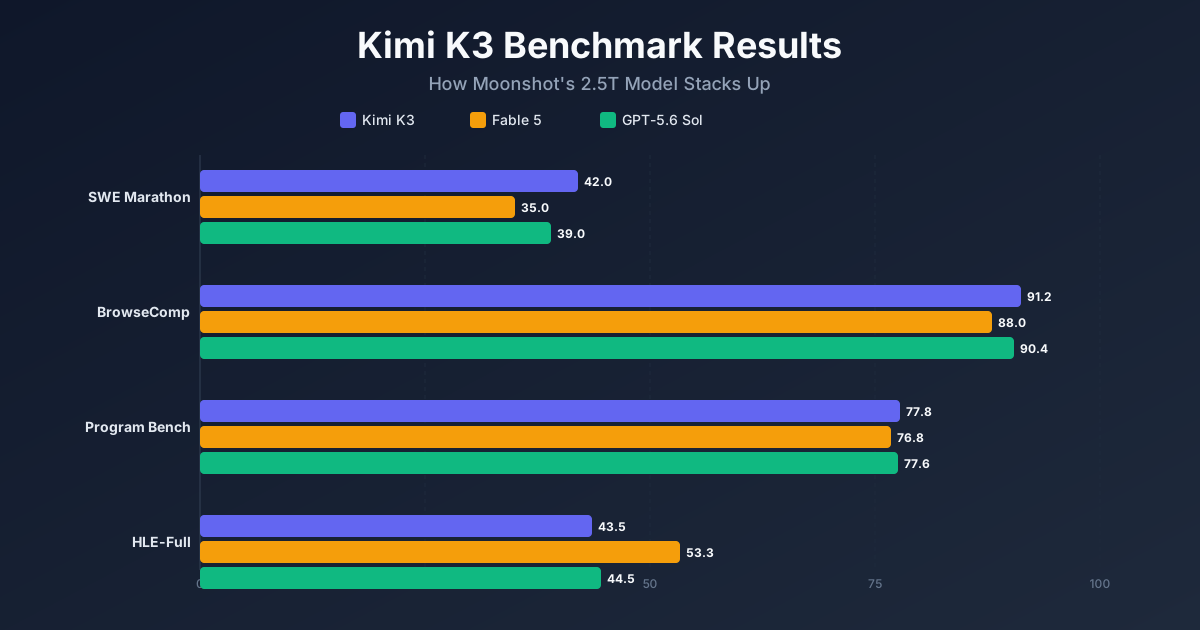
| Program Bench | 77.8 | 76.8 | 77.6 | 71.9 | 70.8 | 63.7 |
| SWE Marathon | 42.0 | 35.0 | 39.0 | 40.0 | 14.0 | 13.0 |
| Kimi Code Bench 2.0 | 72.9 | 76.9 | — | — | — | — |
Where K3 leads:
- Program Bench (77.8): K3 tops every model including Fable 5 and GPT-5.6 Sol. The margin is thin — half a point over GPT-5.6's 77.6 — but it is a genuine first place.
- SWE Marathon (42.0): This is the longest-running software engineering benchmark — tasks that require sustained multi-step reasoning over extended codebases. K3 beats Opus 4.8 (40.0), GPT-5.6 (39.0), and Fable 5 (35.0) by meaningful margins. For teams running agentic coding pipelines, this is the most relevant result in the table.
- SWE-bench Verified (76.8%): Widely cited but harder to contextualize because not all competitors have published comparable scores on the same version.
Where K3 trails:
- DeepSWE (67.5): Behind both GPT-5.6 Sol (73.0) and Fable 5 (70.0). This benchmark tests deep repository understanding — finding and fixing bugs that require reading across multiple files. A 5.5-point gap behind GPT-5.6 is significant.
- FrontierSWE (81.2): Second only to Fable 5's 86.6 — a 5.4-point gap. But K3 beats GPT-5.6 (71.3) by nearly 10 points here, making this benchmark a clear Fable 5 vs. K3 contest.
Rule of thumb: No single coding benchmark tells the full story. DeepSWE tests repo-level understanding. Terminal-Bench tests command-line tool use. SWE Marathon tests sustained multi-step reasoning. Program Bench tests general program construction. K3 wins the endurance benchmarks (Marathon, Program Bench) but loses on deep repo comprehension (DeepSWE). If your workload involves long agentic loops, K3's profile fits. If you need single-pass deep file analysis, Fable 5 and GPT-5.6 still lead.
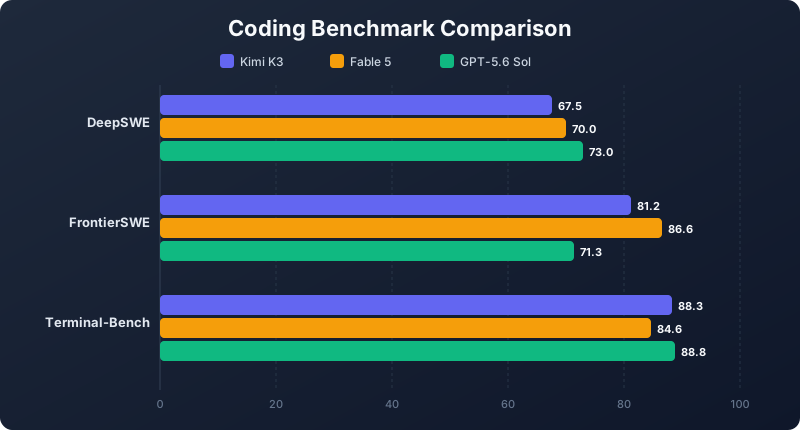
Coding tells a strong but incomplete story. The arena results add a different angle: what do human evaluators actually prefer?
Frontend Code Arena: #1 — But Read the Fine Print
The most headline-grabbing result: Kimi K3 ranked #1 on the Frontend Code Arena at Arena.ai with 1,679 Elo — ahead of Claude Fable 5 (1,631), GPT-5.6 Sol (1,618), and GLM-5.2 (1,587).
K3 ranked first in six of seven frontend domains tested.
This is a human-preference arena, not an automated benchmark. Real users submit frontend coding tasks and vote on which model produces better results. #1 means human evaluators preferred K3's frontend code over every other model available.
For context: the Frontend Code Arena is relatively new and has fewer votes than the main LMArena text leaderboard. On the main LMArena text ranking, K3 sits at 1,486 Elo — competitive but not dominant. The frontend result shows a genuine strength in UI code generation; the overall Arena result shows K3 is solid but not top-tier in general-purpose conversation.
Arena results measure human preference. The next question is whether K3 can execute autonomously — which is what the agentic benchmarks test.
Agentic Benchmarks: The Quiet Strength
Agentic task performance is where K3 most consistently outperforms expectations. It leads on three benchmarks and places competitively on three more.
| Benchmark | Kimi K3 | Fable 5 | GPT-5.6 Sol | Opus 4.8 | GLM-5.2 |
|---|---|---|---|---|---|
| BrowseComp | 91.2 | 88.0 | 90.4 | 84.3 | — |
| Automation Bench | 30.8 | 29.1 | 29.7 | 27.2 | 12.9 |
| SpreadsheetBench 2 | 34.8 | 34.7 | 32.4 | 31.6 | 28.1 |
| JobBench | 52.9 | 57.4 | 46.5 | 48.4 | 43.4 |
| GDPval-AA v2 (Elo) | 1,668 | 1,760 | 1,748 | 1,600 | 1,514 |
| AA-Briefcase (Elo) | 1,548 | 1,583 | 1,495 | 1,354 | 1,260 |
Where K3 leads:
- BrowseComp (91.2): Web browsing comprehension — K3 beats GPT-5.6 (90.4) and Fable 5 (88.0). This was tested with context compaction at 300K tokens; without compaction on the full 1M window, K3 scores 90.4 — still first.
- Automation Bench (30.8): Task automation across diverse environments. K3 beats all competitors, with GPT-5.6 at 29.7 and Fable 5 at 29.1.
- SpreadsheetBench 2 (34.8): Structured data manipulation — K3 edges out Fable 5 by 0.1 points. Narrow, but first is first.
Where K3 trails:
- GDPval-AA v2 (1,668 Elo): The general-purpose agentic evaluation. K3 trails Fable 5 (1,760) by 92 Elo and GPT-5.6 (1,748) by 80 Elo. This is the largest gap in the agentic category.
- JobBench (52.9): Behind Fable 5's 57.4 — a 4.5-point gap on job-related task completion.
Rule of thumb: K3 excels at specific agentic tasks — browsing, automation, data manipulation — but falls behind on general-purpose agentic reasoning (GDPval). If you are building narrow agent pipelines with well-defined tasks, K3 may be the best available model. If you need an agent that handles arbitrary open-ended tasks, Fable 5 still holds the edge.
Agentic performance is about executing tasks. But can K3 actually think? The knowledge and reasoning benchmarks test the foundation underneath the execution.
Knowledge and Reasoning: Frontier-Competitive, Not Frontier-Leading
| Benchmark | Kimi K3 | Fable 5 | GPT-5.6 Sol | Opus 4.8 | GLM-5.2 |
|---|---|---|---|---|---|
| GPQA Diamond | 93.5% | 92.6% | 94.1% | 91.0% | 91.2% |
| HLE-Full | 43.5 | 53.3 | 44.5 | 49.8 | — |
| Humanity's Last Exam | 56% | — | — | — | — |
| AIME 2025 | 96.1% | — | — | — | — |
K3 scores 93.5% on GPQA Diamond — a graduate-level science Q&A benchmark — placing it between Fable 5 (92.6%) and GPT-5.6 (94.1%). This is frontier-competitive.
The weak point is HLE-Full (43.5) — Humanity's Last Exam in full format. Fable 5 scores 53.3, nearly 10 points higher. This benchmark tests extremely difficult reasoning across diverse knowledge domains. K3 trails both Fable 5 and Opus 4.8 here.
AIME 2025 at 96.1% confirms strong mathematical reasoning — near K2.6's 96.4% on AIME 2026, suggesting the math capability carried over despite the architecture change.
Reasoning scores show where K3 runs into its ceiling. But the multimodal results — which were the biggest pre-release unknown — turn out to be one of its genuine strengths.
Multimodal Benchmarks: The Pre-Release Question Mark Turns Into a Strength
Pre-release, multimodal support was the biggest question mark. K3 confirmed it — and the scores are competitive:
| Benchmark | Kimi K3 | Fable 5 | GPT-5.6 Sol | Opus 4.8 |
|---|---|---|---|---|
| MMMU-Pro | 81.6 | 81.2 | 83.0 | 78.9 |
| OmniDocBench | 91.1 | 89.8 | 85.8 | 87.9 |
| CharXiv Reasoning | 91.3 | — | — | — |
| MathVision (w/ Python) | 97.8 | — | — | — |
K3 tops OmniDocBench (91.1) — a document understanding benchmark — beating Fable 5 (89.8) and GPT-5.6 (85.8) by substantial margins. MMMU-Pro at 81.6 is second only to GPT-5.6's 83.0.
For document-heavy workflows — contract analysis, research paper processing, invoice extraction — K3's multimodal results are the most relevant numbers in this article. OmniDocBench specifically tests the ability to understand complex document layouts with mixed text and visual elements.
Individual benchmarks are useful for specific decisions. But if you want a single-number summary of where K3 sits in the field, the composite indexes are the closest thing available.
Artificial Analysis Composite Scores: The Big-Picture View
Artificial Analysis publishes three composite indexes that aggregate multiple benchmarks into comparable scores:
| Index | Kimi K3 Score | Rank | Context |
|---|---|---|---|
| Intelligence Index | 57.11 | #4 of 189 | On par with Opus 4.8 and GPT-5.5 |
| Coding Index | 76.24 | — | — |
| Agentic Index | 50.07 | — | — |
The Intelligence Index ranking — #4 out of 189 models, on par with Opus 4.8 — is a strong signal. It means K3 is consistently competitive across multiple dimensions, not just selectively strong on cherry-picked benchmarks.
Output speed: 62 tokens/second with 1.99-second time-to-first-token. Fast enough for interactive use but not the fastest model available.
Composite scores confirm: K3 is a top-5 model overall. But performance is only half the equation. The other half is what it costs — and this is where the biggest surprise landed.
Pricing Reality Check: The Leaked Numbers Were Wrong
This matters enough to highlight separately. The leaked pricing and actual pricing are dramatically different:
| Leaked Estimate | Actual Price | Difference | |
|---|---|---|---|
| Input (per 1M tokens) | $0.80–1.20 | $3.00 | 2.5–3.75× higher |
| Cached input (per 1M tokens) | — | $0.30 | New: heavy discount for cache hits |
| Output (per 1M tokens) | $3.50–4.50 | $15.00 | 3.3–4.3× higher |
| Web search | — | $0.015/call | — |
At $3/$15, K3 is not the ultra-cheap frontier model the leaks suggested. It sits closer to established pricing tiers:
| Model | Input/1M | Output/1M | Context |
|---|---|---|---|
| Claude Opus 4.8 | $15.00 | $75.00 | 200K |
| GPT-5.6 Sol | ~$10.00 | ~$30.00 | 128K |
| Kimi K3 | $3.00 | $15.00 | 1M |
| GLM-5.2 | $1.40 | $4.40 | 128K |
| DeepSeek V4 Pro | ~$0.50 | ~$2.00 | 128K |
K3 is still significantly cheaper than Opus 4.8 and GPT-5.6 — roughly 70–80% cheaper on output tokens. But the "90–95% cheaper" narrative from the leaked pricing is dead. And the $0.30 cached input rate means K3's cost advantage is strongest for workloads with high cache hit rates — repeated prompts, batch processing with shared system prompts, RAG pipelines with stable context.
Rule of thumb: If your pipeline hits >50% cache rate, effective input cost drops to ~$1.65/MTok blended. If every call is unique context, you pay the full $3.00. Know your cache hit ratio before projecting cost savings.
Expert pitfall: Do not compare K3 and Opus pricing at face value without adjusting for context window. K3 offers 1M tokens of context; Opus 4.8 offers 200K. If your workload requires chunking a 500K-token document into 3 Opus calls, the effective Opus cost is 3× the single-call rate. K3 handles it in one call. Per-token pricing comparisons only tell the truth when both models can process the same input in the same number of calls.
The pricing puts K3 in a different competitive bracket than the leaks suggested. The question is whether upgrading from K2.6 — Moonshot's previous model — is worth the cost jump.
K3 vs. K2.6: Did the Upgrade Deliver?
K2.6 was Moonshot's previous flagship. Here is how K3 compares on available benchmarks:
| Metric | K2.6 | K3 | Change |
|---|---|---|---|
| Total parameters | ~1T | 2.8T | +180% |
| Context window | 256K | 1M | +4× |
| SWE-bench Verified | 80.2% | 76.8% | −3.4% |
| AIME 2025/2026 | 96.4% | 96.1% | −0.3% |
| Program Bench | 53.6 | 77.8 | +45% |
| Kimi Code Bench 2.0 | 62.0 | 72.9 | +17.6% |
| Pricing (input) | $0.60 | $3.00 | +5× |
| Pricing (output) | $2.50 | $15.00 | +6× |
The coding benchmarks show massive improvement — Program Bench jumped from 53.6 to 77.8 (+45%), and Kimi Code Bench from 62.0 to 72.9. These were K2.6's weakest points.
The SWE-bench Verified score dropped from 80.2% to 76.8%. This likely reflects different benchmark versions or evaluation conditions rather than an actual regression — K3's broader benchmark profile is clearly stronger than K2.6's.
The cost increased substantially. K2.6 at $0.60/$2.50 was one of the cheapest frontier models. K3 at $3.00/$15.00 is competitive but no longer the budget option. For existing K2.6 users, the upgrade decision hinges on whether the coding improvements and 1M context justify a 5–6× price increase.
The biggest factor that could change the equation is open weights — which have a confirmed date.
Open Weights: July 27
Moonshot confirmed open weights will be released on July 27, 2026. This makes K3 the largest open-weight model at 2.8T parameters — surpassing DeepSeek V4 Pro (1.6T) and ERNIE 5.0 (~2.4T).
What this means in practice:
- Self-hosting: At 2.8T MoE with 896 experts, you need serious hardware. Expect quantized versions (4-bit, 1-bit GGUF) to follow within weeks, similar to how the community handled Hunyuan 3.
- Fine-tuning: Possible on the active parameter set (~16 experts worth), but requires MoE-aware fine-tuning infrastructure. Most teams will want to wait for community tooling.
- Inference optimization: Kimi Delta Attention enables the 1M context at reasonable throughput. Open weights mean independent researchers can verify the claimed 6.3× decoding speedup.
If you need open weights for compliance, audit, or domain adaptation, July 27 is the date to watch. But before you commit to K3 based on the numbers above, there are several things the benchmark table does not show.
Which Model for Which Task: A Decision Framework
Benchmarks are useful. But if you are choosing a model for a specific workload, you need a decision matrix — not a leaderboard.
| Your Primary Workload | Best Model (Based on Benchmarks) | Runner-Up | Why |
|---|---|---|---|
| Agentic coding pipelines (multi-step, long loops) | Kimi K3 | Opus 4.8 | K3 wins SWE Marathon (42.0) and Program Bench (77.8) — the endurance tests |
| Deep repo bug hunting (single-pass analysis) | GPT-5.6 Sol | Fable 5 | GPT-5.6 wins DeepSWE (73.0); Fable 5 wins FrontierSWE (86.6) |
| Frontend / UI code generation | Kimi K3 | Fable 5 | K3 is #1 on Frontend Code Arena (1,679 Elo) |
| Web browsing and automation tasks | Kimi K3 | GPT-5.6 Sol | K3 wins BrowseComp (91.2) and Automation Bench (30.8) |
| Hard reasoning and knowledge problems | Fable 5 | GPT-5.6 Sol | Fable 5 wins HLE-Full (53.3) by a 10-point margin |
| Document understanding (images, layouts) | Kimi K3 | Fable 5 | K3 wins OmniDocBench (91.1); also tops CharXiv and MathVision |
| General-purpose open-ended agentic tasks | Fable 5 | GPT-5.6 Sol | Fable 5 wins GDPval (1,760 Elo) — the general agentic eval |
| Budget-sensitive high-volume API calls | GLM-5.2 or DeepSeek V4 Pro | Kimi K3 | K3 at $3/$15 is cheaper than Opus/GPT but 2–7× more than GLM/DeepSeek |
| Open-weight requirement (self-hosting, fine-tuning) | Kimi K3 (after July 27) | Inkling | K3 at 2.8T will be the largest open-weight model; Inkling at 975B is available now |
Rule of thumb: If your workflow involves multiple model calls in a loop (agent pipelines, iterative refinement, RAG with reranking), K3's combination of strong endurance benchmarks, 1M context, and lower-than-Opus pricing is a strong fit. If your workflow is single-shot reasoning on hard problems, Fable 5 still has the edge. Do not switch models based on a single benchmark — match the benchmark category to your actual task.
How to Verify K3's Performance Yourself (20-Minute Test)
Benchmark tables tell you how a model performed on someone else's tasks. Here is how to check if K3 works for yours — before committing any budget.
Step 1: Identify your hardest test case (5 minutes). Pick the task that currently causes the most friction with your existing model. Long-context analysis? Multi-step code generation? Document extraction? Write out the exact prompt you would use.
Step 2: Run the same prompt on K3 and your current model (10 minutes). Go to kimi.com — free tier, no credit card, sign up with Google. Run your test prompt. Then run the identical prompt on your current model (Claude, GPT, DeepSeek). Compare the outputs side by side.
Step 3: Check the specific metrics that matter to you (5 minutes). For coding: does the output compile and pass tests? For document analysis: does it extract the right fields? For long-context: does it reference information from early in the context? One concrete comparison on your own task tells you more than every benchmark in this article.
If you need API access: Sign up at platform.moonshot.cn. The cached input rate ($0.30/MTok) makes it cheap to test with repeated system prompts.
What the Benchmarks Don't Tell You
Every benchmark table has blind spots. Here are K3's:
No long-context retrieval benchmarks published. K3 claims 1M context, and BrowseComp at 91.2% suggests it works at 300K tokens. But there are no published needle-in-a-haystack scores at 500K or 1M. The 1M claim remains unverified by independent evaluators at extreme lengths.
Always-on reasoning with no effort control yet. K3 launched with reasoning_effort tunable, but only max level is available at launch. Lower effort levels (which reduce cost and latency) are coming later. Until then, every API call pays for maximum reasoning whether you need it or not.
No independent Chatbot Arena ranking stabilized. K3 appears on LMArena at 1,486 Elo, but the confidence interval (±10.8) is wide. Arena rankings take weeks to stabilize with enough votes.
BenchLM coverage is incomplete. As of July 17, K3 has published 52 of 313 tracked benchmarks — not enough for an overall leaderboard rank. The numbers above are real, but they represent Moonshot's chosen evaluation suite, not comprehensive independent testing.
Rule of thumb: When a model launches with a broad but selectively chosen benchmark table, check what is missing. K3's table is strongest on coding and agentic tasks, weakest on general reasoning (HLE) and general conversation (Arena text). If your use case is coding or automation, the published benchmarks are directly relevant. If your use case is open-ended conversation or creative writing, wait for broader independent coverage.
FAQ
What are the official Kimi K3 benchmark scores?
Key results: SWE-bench Verified 76.8%, FrontierSWE 81.2, Terminal-Bench 2.1 88.3, Program Bench 77.8, SWE Marathon 42.0, BrowseComp 91.2, GPQA Diamond 93.5%, MMMU-Pro 81.6. K3 ranks #1 on Frontend Code Arena with 1,679 Elo and #4 on the Artificial Analysis Intelligence Index.
How does Kimi K3 compare to GPT-5.6 on coding benchmarks?
Mixed results. K3 wins on FrontierSWE (81.2 vs 71.3), Program Bench (77.8 vs 77.6), and SWE Marathon (42.0 vs 39.0). GPT-5.6 wins on DeepSWE (73.0 vs 67.5) and Terminal-Bench 2.1 (88.8 vs 88.3). Neither model dominates across all coding benchmarks.
How does Kimi K3 compare to Claude Fable 5?
Fable 5 leads on DeepSWE (70.0 vs 67.5), FrontierSWE (86.6 vs 81.2), HLE-Full (53.3 vs 43.5), and GDPval general agentic reasoning (1,760 vs 1,668 Elo). K3 leads on Program Bench (77.8 vs 76.8), SWE Marathon (42.0 vs 35.0), BrowseComp (91.2 vs 88.0), and Frontend Code Arena (1,679 vs 1,631 Elo). Fable 5 is stronger on deep reasoning; K3 is stronger on sustained execution and frontend code.
How does Kimi K3 compare to Claude Opus 4.8?
K3 outperforms Opus 4.8 on virtually every published benchmark. The gaps are largest on coding (DeepSWE 67.5 vs 59.0, FrontierSWE 81.2 vs 66.7) and agentic tasks (BrowseComp 91.2 vs 84.3). At $3/$15 versus Opus 4.8's $15/$75, K3 also costs 70–80% less.
Is Kimi K3 the best open-weight model?
On coding and agentic benchmarks, yes — no current open-weight model matches K3's scores. On general reasoning (HLE-Full), Inkling and GLM-5.2 may be competitive but lack directly comparable published results. Open weights release on July 27 will allow independent verification.
What is Kimi K3's Chatbot Arena ranking?
K3 holds 1,486 Elo (±10.8) on the main LMArena text leaderboard as of July 17, 2026. On the Frontend Code Arena specifically, K3 is #1 at 1,679 Elo. Arena rankings are still stabilizing — expect the confidence interval to narrow over the coming weeks.
How much does Kimi K3 cost?
$3.00 per million input tokens (cache miss), $0.30 per million cached input tokens, $15.00 per million output tokens, $0.015 per web search call. These rates are 3–4× higher than pre-release leaked estimates but still 70–80% cheaper than Claude Opus 4.8 on output tokens.
When will Kimi K3 open weights be available?
July 27, 2026. Moonshot confirmed the date at launch. K3 at 2.8T parameters will be the largest open-weight model available. Quantized versions for consumer hardware are expected to follow from the community.
Bottom Line
The benchmark table does not lie, but it does not tell the whole truth either.
Kimi K3 holds verifiable first-place results on Program Bench, SWE Marathon, BrowseComp, Automation Bench, Frontend Code Arena, and OmniDocBench. These are not cherry-picked vibes — they are reproducible scores against the strongest models available. On sustained coding execution and task automation, K3 is the best model you can use today.
But the leaderboard has two sides. Fable 5 leads by 10 points on HLE-Full reasoning. GPT-5.6 leads by 5.5 points on DeepSWE. The pricing landed at $3/$15 — competitive with the field, not the 10× disruption the leaks promised.
Here is what matters: K3 is not a "better model" or a "worse model." It is a model with a specific performance shape — strong on endurance, automation, frontend code, and document understanding; weaker on single-pass deep reasoning and deep repo comprehension. Knowing that shape is worth more than knowing the overall rank.
Your next step: Go to kimi.com, sign up in 60 seconds, and run your hardest task. If it outperforms your current model on the work you actually do, switch. If it does not, you saved yourself from hype-driven infrastructure churn. Open weights drop July 27 — if self-hosting matters to you, that is the date to circle.