
Table of Contents

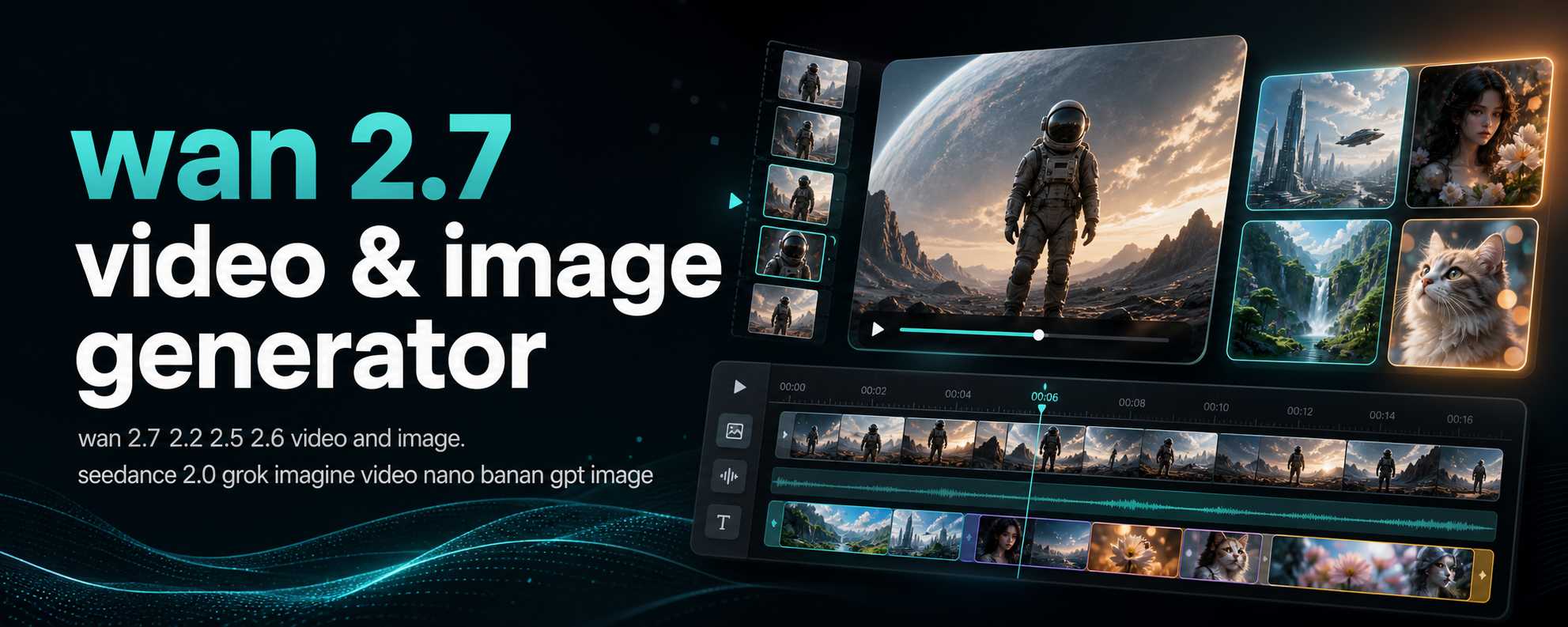
The short version: Wan 2.6 gave you better output. Wan 2.7 gives you control.
Both are powerful. But they solve different problems. Here is exactly what changed, what stayed, and whether the upgrade is worth it for your workflow.

What Wan 2.6 Was Built For
When Alibaba released Wan 2.6 in December 2025, the focus was cinematic output quality at scale:
- Starring — cast a real person from a reference video into a new scene. Multi-person interactions, appearance and voice consistency.
- Intelligent Multi-shot Narrative — turn a simple prompt into an auto-storyboarded multi-shot video with visual consistency across cuts.
- Native A/V Sync — multi-speaker dialogue with natural lip sync and studio-quality audio. Up to 15 seconds at 1080p HD.
- Advanced Image Synthesis — multi-image referencing for commercial-grade consistency and faithful aesthetic transfer.
- Storytelling with Structure — interleaved text and images with real-world knowledge and reasoning.
Wan 2.6 was the model you reached for when you needed something that looked professional out of the box.
The limitation: You described what you wanted, and hoped the model landed near it. Boundaries, transitions, and shot intent were largely out of your hands.
What Wan 2.7 Changes
Wan 2.7 is an all-around upgrade over 2.6 — confirmed by the Wan team and consistent across every early report. Here is every new capability.
1. First-Frame & Last-Frame Video Generation
The single most-requested feature in AI video, finally here.
You define the opening frame and the closing frame. Wan 2.7 generates the motion in between. This is not a filter or a trick — it is a fundamental change in how you plan shots.
Wan 2.6: Prompt only. The model decides where the shot starts and ends.
Wan 2.7: You set both boundaries. The model fills the motion.
For directors, storyboarders, and ad teams working to tight shot specs, this is the feature that makes Wan production-viable.
2. 9-Grid Image-to-Video
Feed Wan 2.7 a 3×3 board of nine images. It generates a video from that structured visual input.
Wan 2.6: Single image or text as input for video generation.
Wan 2.7: Nine-image structured boards → richer, more directed motion output.
This closes the gap between storyboard and screen. You no longer have to describe a multi-angle scene in text — you show it.
3. Subject + Voice Reference (Combined)
Wan 2.6's Starring feature supported appearance consistency from video references. Wan 2.7 extends this with dual conditioning: you can now guide both the visual identity and the vocal style of a subject in the same generation.
Wan 2.6: Appearance reference from video → new scene.
Wan 2.7: Appearance reference + voice reference → consistent character in new scene with matching speech and tone.
For creator content, talking-head formats, and localized video variants, this is a meaningful step forward.
4. Instruction-Based Video Editing
In Wan 2.6, if something was wrong with a clip, you regenerated it.
In Wan 2.7, you describe the change in plain language. The model applies the edit to the existing video — motion, framing, style, timing, background — while preserving what was working.
Wan 2.6: Iterate by regenerating.
Wan 2.7: Iterate by instruction.
This alone cuts the cost of revision cycles significantly for teams doing multiple rounds of feedback.
5. Video Recreation / Replication
Take a clip that works and rebuild it into new versions. Wan 2.7 preserves the original motion structure, pacing, and performance direction while allowing you to change subjects, styles, or context.
Wan 2.6: Each generation is independent.
Wan 2.7: One strong take scales into multiple deliverables — localization, A/B hooks, platform variants. For a full workflow guide, see Wan 2.7 Video Recreation Guide.
Wan 2.7 Image: A Separate Release Worth Noting
On April 1, 2026, Alibaba also launched Wan 2.7 Image — a unified image generation and editing model. It is a standalone product but worth including in any wan 2.7 vs wan 2.6 comparison.
Wan 2.6 had advanced image synthesis tied to its video workflow. Wan 2.7 Image breaks image generation out into its own dedicated model with:
- Precise face control — distinct characters, not the same AI face repeated
- 8-Hex color palette — brand-accurate color without post-processing
- 4,000-character text rendering — multilingual, formulas, tables, inside the image
- Region-level editing — change exactly what you select, nothing else
- Transparent PNG export — clean cutouts built in
If your workflow involves any image output at all, this is a bigger upgrade than it might initially seem.
Side-by-Side: Wan 2.6 vs Wan 2.7
| Capability | Wan 2.6 | Wan 2.7 |
|---|---|---|
| Text-to-video | ✅ | ✅ Enhanced |
| Image-to-video | Single image | 9-grid board |
| Shot boundaries | Prompt-guided | First + last frame |
| Subject reference | Appearance only | Appearance + voice |
| Video editing | Regenerate | Instruction-based |
| Video recreation | ❌ | ✅ |
| Audio / lip sync | ✅ Native A/V | ✅ Carried forward |
| Multi-shot narrative | ✅ | ✅ |
| Image generation | Integrated (2.6) | Dedicated model (2.7 Image) |
| Max resolution | 1080p 15s | 1080p improved |
Should You Upgrade?
Yes, if any of these apply:
- Your workflow requires specific shot transitions or controlled motion direction
- You produce recurring character-led content and need voice + appearance consistency together
- Your team does revision rounds — instruction editing cuts regeneration cycles significantly
- You need to produce campaign variants or localized video versions from one source
- Image generation is part of your pipeline — Wan 2.7 Image is a meaningful standalone upgrade
Wan 2.6 is still worth using if:
- You rely heavily on the Starring feature and want to verify Wan 2.7 parity before switching
- Your workflow is optimized and stable, and the upgrade overhead outweighs the new features for now
Bottom Line
Wan 2.6 was about generating better results. Wan 2.7 is about controlling exactly what those results are.
The five new capabilities — first/last frame, 9-grid I2V, dual reference, instruction editing, and recreation — each solve a specific gap that made Wan 2.6 harder to use in real production. Together, they represent a shift from AI-as-generator to AI-as-directed-collaborator.
Try Wan 2.7 at Wan 2.7.
If you're also comparing the Wan 2.5 workflow, see Wan 2.5 vs Wan 2.7: Which Workflow Should You Use?.