
Table of Contents

You search "wan 2.5 open source."
One provider calls it "open-source video generation." A blog says Apache 2.0. A GitHub issue says Alibaba abandoned the community. A platform page just shows you an API key field and a pricing table.
Meanwhile, you are sitting there trying to answer one practical question:
Can I download Wan 2.5 and run it on my own machine?
That is the question this page actually answers.
By the end of this guide, you will know whether Wan 2.5 is open source or not, why the signals are so mixed, which access path fits your use case, and what your real alternatives are. This analysis is based on direct tracking of the Wan model family since its first release, including official Alibaba announcements, HuggingFace repository audits, and ongoing community monitoring.
The Short Answer: Wan 2.5 Is Not Open Source
No, Wan 2.5 is not open source. It is not open-weight. It is not available under any open-source license.
Wan 2.5 was previewed at Alibaba's Apsara Conference in September 2025 and released as a commercial API through Alibaba Cloud's Bailian (Model Studio) platform and third-party providers. The model weights were never published to HuggingFace, GitHub, or ModelScope.
This was a departure from how Alibaba handled earlier Wan versions. Wan 2.1 and Wan 2.2 were both released under permissive open-source licenses with downloadable weights. Wan 2.5 moved to a closed API model.
If you are looking for an open-weight video generation model from the Wan family, Wan 2.2 is the last version with publicly available weights under Apache 2.0.
If you want to use Wan 2.5's capabilities — especially native audio-sync video — the hosted API is your only path.
Why There Is So Much Confusion Around Wan 2.5 Open Source
The mixed signals are not accidental. Four things drive the noise, and understanding each one helps you filter search results and marketing claims more reliably.
1. API Providers Market It as "Open Source"
Third-party platforms list Wan 2.5 among their models. Some label it "open source" or "open weights" in their marketing copy. What they mean is: they host the model, and you access it via their API. The model itself remains closed. The "open source" label describes the platform's general catalog positioning, not Wan 2.5's actual license.
Expert pitfall: When a provider lists "Wan 2.5" alongside models like Stable Diffusion or Llama that have actual open-weight releases, it creates a catalog-level implication that Wan 2.5 shares the same openness. It does not. Always check whether there is a HuggingFace repository or GitHub release page before believing the "open source" label on a model listing page.
Searching for "wan2.5" (no space) returns the same results — API provider pages dominate, not a HuggingFace download page.
2. Older Wan Versions Actually Are Open Source
Wan 2.1 (Apache 2.0) and Wan 2.2 (Apache 2.0) have publicly downloadable weights on HuggingFace. Many articles, reviews, and comparison pages reference these versions. When someone says "Wan is open source," they are often describing Wan 2.2 — not Wan 2.5.
3. The "Preview" Label Created False Expectations
Wan 2.5 was announced as "Wan 2.5-Preview." That word "Preview" led many in the community to believe open weights would follow after the preview period — the same pattern Alibaba used with earlier Wan versions. It has been nearly a year since the preview launch. No weights have been released.
4. Third-Party Sites Use "Wan 2.5" in Their Product Names
Several consumer-facing apps and websites use "Wan 2.5" in their branding. When you visit a site like wan2-5.app, you are using a hosted wrapper around the API, not running the model yourself. The product name implies something more open than what is actually happening.
Why Alibaba Moved Wan 2.5 to a Closed Model
Understanding the reason behind the shift helps set realistic expectations — and it also explains why Wan 2.5 weights are unlikely to ever appear.
Wan 2.5 introduced two capabilities that earlier open-weight versions lacked: native audio-sync video and significantly higher resolution (1080p vs 720p). Both features require substantial inference infrastructure — audio-video alignment models are compute-intensive to serve, and Alibaba made a strategic decision to monetize this capability rather than give it away.
The pattern is not unique to Alibaba. Across the AI video generation space, the industry trend in 2025–2026 is toward tiered access: baseline models remain open, while premium capabilities (higher resolution, multi-modal output, faster inference) are kept behind API paywalls. Runway, Pika, and Kling all follow similar strategies.
Rule of thumb: When a new Wan version introduces a capability that would be expensive for typical users to self-host (audio sync, 4K, real-time generation), it is increasingly likely to be API-only. Open-weight releases tend to be versions that can run on consumer-grade hardware within reasonable time.
Wan Version Open-Source Status: Complete Comparison
This table shows where each major Wan version stands as of July 2026. It covers the full version lineage from Wan 2.1 through the pre-announced Wan 3.0.
| Version | Released | Public Weights? | License | How to Access |
|---|---|---|---|---|
| Wan 2.1 | Feb 2025 | ✅ Yes | Apache 2.0 | HuggingFace Wan-AI/Wan2.1-* |
| Wan 2.2 | Jul 2025 | ✅ Yes | Apache 2.0 | HuggingFace Wan-AI/Wan2.2-* |
| Wan 2.2-S2V | Aug 2025 | ✅ Yes | Apache 2.0 | HuggingFace |
| Wan 2.2-Animate | Sep 2025 | ✅ Yes | Apache 2.0 | HuggingFace |
| Wan 2.5 | Sep 2025 (Preview) | ❌ No | Commercial API | Alibaba Cloud / API Providers |
| Wan 2.6 | Dec 2025 | ❌ No | Commercial API | Alibaba Cloud |
| Wan 2.7 | Mar 2026 | ✅ Yes (select models) | Apache 2.0 | HuggingFace, see the Wan 2.7 Open Source Guide |
| Wan 3.0 | Expected mid-2026 | 🔮 Pre-announced Apache 2.0 | Apache 2.0 (planned) | Not yet released |
The pattern is uneven. Open-weight releases cover Wan 2.1, 2.2, and 2.7, but Wan 2.5 and 2.6 — the versions that introduced the most significant capability leaps — remained commercial. The gap between "announced as open source" and "weights actually published" is where the Wan 2.5 debate lives.
Rule of thumb: If audio-sync video or 1080p output is a hard requirement, use Wan 2.5 via API and treat the cost as a production expense. If self-hosting, privacy, or fine-tuning matters more, skip Wan 2.5 entirely and go straight to Wan 2.2 open weights. Do not wait for Wan 2.5 weights to drop — they have not come in nearly a year.
What Wan 2.5 Offers That Open-Weight Versions Do Not
If you are comparing Wan 2.5 (closed API) against Wan 2.2 (open weights), here is what you gain by using the hosted version — and what you give up.
| Capability | Wan 2.5 (API) | Wan 2.2 (Open Weights) |
|---|---|---|
| Native synchronized audio | ✅ Yes — dialogue, SFX, music | ❌ Audio not supported |
| Resolution | Up to 1080p @ 24fps | Up to 720p |
| Max clip length | Up to 10 seconds | Up to 5 seconds |
| Lip-sync | ✅ Yes | ❌ No |
| Multilingual prompts | ✅ 8+ languages | Limited English / Chinese |
| 4K preview | ✅ Available (preview tier) | ❌ No |
The audio-video sync is the standout. Wan 2.5 generates video with matching dialogue, sound effects, and background music in a single pass — no post-production audio alignment needed. In practice, a 10-second audio-sync clip takes roughly 30–60 seconds through the API, compared to a multi-step workflow (separate video + audio generation + manual alignment) that takes 15–30 minutes for similar output.
The trade-off is structural: the API version runs on Alibaba Cloud's servers, meaning your data passes through their infrastructure, you pay per second of output ($0.30–$0.40/sec), and you cannot fine-tune or modify the model. The open-weight version gives you full control, but lacks the core features that make Wan 2.5 notable.
Once you have compared the capabilities, the next question is where to actually access Wan 2.5.
Where to Access Wan 2.5 Today (3 Paths Compared by Cost and Control)
Even without open weights, Wan 2.5 is accessible through three paths. The choice depends on your workflow, budget, and control requirements.
Path A: Alibaba Cloud Bailian (Model Studio)
The official first-party access point. Full Wan 2.5 capability: native audio-sync video, 1080p, multilingual prompts.
- Pricing: Approximately $0.30–$0.40 per second of video
- Best for: Production workflows where reliability and speed matter
- Trade-off: No model access, no customization, data passes through Alibaba Cloud
- Typical latency: 30–60 seconds for a 10-second audio-sync clip
Path B: Third-Party API Providers
Platforms like Replicate, fal.ai, and ModelsLab host Wan 2.5 behind unified APIs.
- Pricing: Varies, roughly $0.03–$0.05 per image, $0.05+ per video generation
- Best for: Quick testing, integration into existing pipelines
- Trade-off: Slight premium over direct API, queue times during peak usage
- Typical latency: 15–120 seconds depending on platform queue
Path C: wan27.org (Browser-First Workflow)
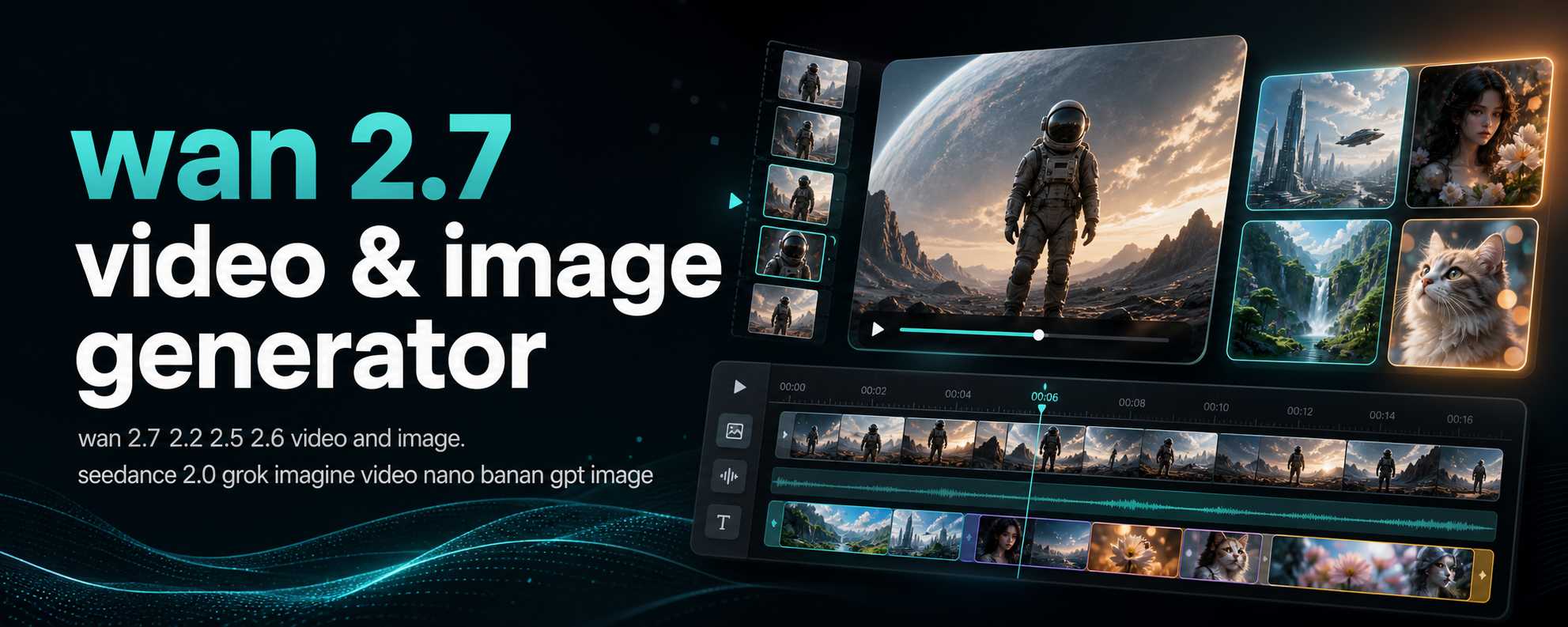
Wan 2.7 provides a browser-based Wan 2.5 workflow with text-to-video and image-to-video modes, 5-second and 10-second clips at 720p or 1080p.
- Best for: Creators who want to test Wan 2.5 output before committing to API integration
- Trade-off: Browser-based, less programmatic control than direct API
Low-friction verification step: Before investing in an API plan or building an integration pipeline, generate 3–5 test clips through wan27.org's browser workflow at 720p. This typically costs under $1 per clip and confirms whether Wan 2.5's output quality meets your requirements — especially the audio-sync quality, which varies by prompt language and content type. If the browser output looks good, the API output at the same resolution will match or exceed it.
Best Open-Weight Alternatives for Self-Hosting Video Models
If self-hosting is your priority, here are your best options.
Wan 2.2 (Apache 2.0) — Recommended
The latest open-weight Wan version with full commercial permissiveness. On a single RTX 4090 (24GB VRAM), the 14B model averages 4–6 seconds per generated frame at 720p. The 1.3B variant runs on 6GB GPUs (RTX 3060 or better) with 2–3 seconds per frame but noticeably lower visual quality.
# Download Wan 2.2 T2V (14B)
huggingface-cli download Wan-AI/Wan2.2-T2V-A14B --local-dir ./wan-t2v-14b

# Download Wan 2.2 I2V (14B)
huggingface-cli download Wan-AI/Wan2.2-I2V-A14B --local-dir ./wan-i2v-14b
Hardware minimum: 24GB VRAM for the 14B model, 6GB for the 1.3B variant. Estimated inference time: 30–90 seconds for a 5-second clip at 720p on a 24GB GPU, depending on sampling steps.
Community tooling: ComfyUI nodes, Diffusers integration, LoRA training scripts — all active and well documented.
Wan 2.1 (Apache 2.0) — Lightweight Alternative
Lower quality ceiling than 2.2, but lighter on hardware. Runs on consumer GPUs more easily — tested stable on 12GB VRAM. Same permissive Apache 2.0 license.
Third-Party Open Models
If you are open to leaving the Wan ecosystem, several open-weight video models exist:
- CogVideoX — Open weights, 5-second clips, good community support. Requires ~18GB VRAM.
- Mochi 1 — Open weights, strong motion coherence, requires ~28GB VRAM.
- LTX Video — Lightweight open model, runs on 8GB GPUs, lower output quality.
None of these match Wan 2.5's native audio-sync capability, but they give you genuine self-hosting with no per-generation cost.
Troubleshooting Common Confusion Points
Symptom: I see "Wan 2.5" listed on HuggingFace but cannot find the weights
Root cause: The Wan-AI organization on HuggingFace hosts Wan 2.1 and Wan 2.2 families. Wan 2.5 is not there. A search result showing "Wan 2.5" on HuggingFace may be a community space or discussion page referencing the model, not the model weights.
Resolution: Search for "wan2.5" on HuggingFace, check whether the repository publisher is Wan-AI, and confirm the repository name contains "Wan2.5" directly (not "Wan2.2" or "Wan2.1"). If the publisher is a third-party user, it is a community adapter or LoRA, not original weights.
Symptom: An API provider says Wan 2.5 is "open source"
Root cause: The provider is describing their platform's model catalog positioning, not Wan 2.5's specific license. Some platforms use "open source" to signal developer accessibility — meaning you can integrate it via API — not that weights are downloadable.
Resolution: Ask two questions: (1) Is there a HuggingFace repository with downloadable weights? (2) Is there a GitHub repository with the model architecture code? If the answer to both is no, Wan 2.5 is not open source, regardless of the provider's language.
Symptom: I downloaded something called "wan2.5" from a third-party site
Root cause: Third-party repositories sometimes rename Wan 2.2 checkpoints as "Wan 2.5" to attract search traffic, or host adapter weights (LoRA, ControlNet) trained for Wan 2.2 under a misleading label.
Resolution: Verify the checkpoint's actual architecture by checking config.json for model dimension counts. Wan 2.5's architecture has not been published, so any downloadable "Wan 2.5" checkpoint is either mislabeled or a Wan 2.2 derivative.
Responsible Usage and Cost Considerations
Cost Planning
Wan 2.5 API costs accumulate faster than most new users expect. At $0.30–$0.40 per second, a 30-second final video (requiring roughly 3 generations for the right take) costs approximately $27–$36. For a project with 10 minutes of generated video, budget at least $180–$360 depending on iteration volume.
Rule of thumb: Budget 3× the theoretical cost of your final video length to account for retakes and prompt refinement. If that multiple exceeds your project budget, start with 720p output and 5-second clips, then scale up.
- Low-budget testing: Use 720p output and shorter clips (5 seconds) to reduce per-generation cost
- Bulk pricing: Some third-party providers offer volume discounts above $500/month spend
- Free tiers: Alibaba Cloud and select providers offer $10–$50 in initial credits; verify credit expiry before committing
Data Privacy
All Wan 2.5 API usage sends your prompts and generated outputs through the provider's infrastructure. Review the provider's data handling policy for:
- Whether generated content is used for model training
- How long prompts and outputs are retained
- Whether the provider supports data deletion on request
If data privacy is a hard constraint, switch to Wan 2.2 open weights on your own hardware — this is the only way to guarantee your prompts and outputs never leave your machine.
What About Wan 3.0?
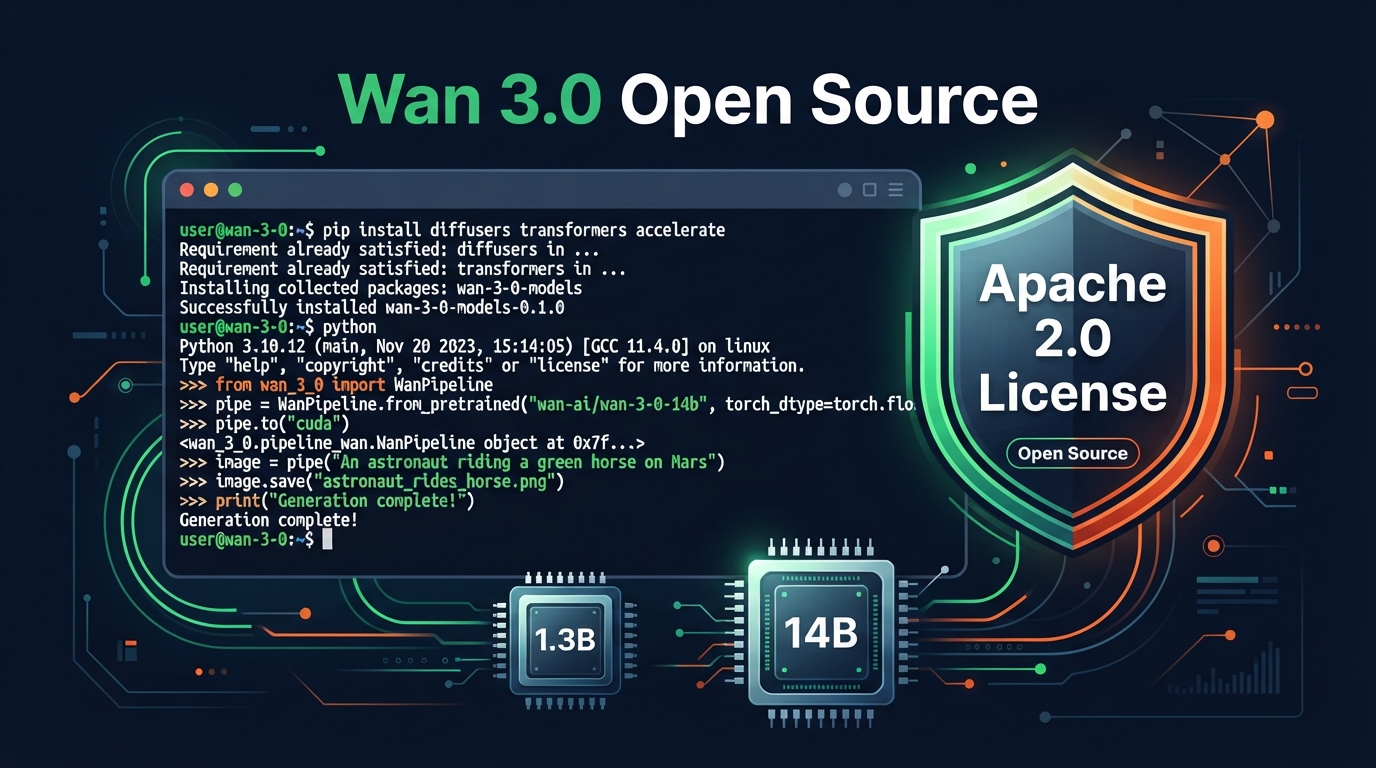
Alibaba has pre-announced that Wan 3.0 will return to an Apache 2.0 open-weight release, expected in mid-2026. If that holds, it would mark a return to the open-source strategy that defined the early Wan series.
However, the Wan 2.5 experience has made the community cautious. The gap between "pre-announced" and "weights published" is where expectations broke down before. Until the actual HuggingFace repository goes live, treat the Wan 3.0 open-source promise as a plan — not a commitment.
FAQ
Is Wan 2.5 open source?
No. Wan 2.5 was released as a commercial API. The model weights have not been published, and the model is not available under any open-source license.
Is Wan 2.5 Apache 2.0 licensed?
No. The Apache 2.0 license applies to Wan 2.1, Wan 2.2, and the select Wan 2.7 models that have open-weight releases. Wan 2.5 is a closed commercial product.
Can I download Wan 2.5 weights?
No. There is no HuggingFace repository, GitHub release, or ModelScope checkpoint for Wan 2.5 model weights.
Is Alibaba Wan 2.5 free?
Wan 2.5 is not free. Access is through paid API tiers. Some platforms offer limited free credits or trial generations, but sustained use requires payment.
Will Wan 2.5 ever be open-sourced?
As of July 2026, Alibaba has not published Wan 2.5 weights and has made no commitment to do so. Wan 3.0 has been pre-announced as Apache 2.0, but Wan 2.5 remains closed.
Is Wan 2.5 available on HuggingFace?
Not as model weights. The Wan-AI HuggingFace organization hosts Wan 2.1 and Wan 2.2 variants. Wan 2.5 is not available there.
What is the difference between Wan 2.5 and open-weight Wan versions?
Wan 2.5 adds native audio-sync video generation, 1080p resolution, 10-second clip length, and lip-sync support — features that earlier open-weight versions like Wan 2.2 do not have. However, Wan 2.5 requires the API, while Wan 2.2 can run locally.
Is Wan 2.5 on Replicate or fal.ai open source?
No. These platforms host Wan 2.5 on their infrastructure and provide API access. The model itself is not open source. Access through these platforms is still API-based, not self-hosted.
Can I use Wan 2.5 for commercial projects?
Yes, through the commercial API. The API terms of service permit commercial use of generated outputs. However, you cannot self-host, fine-tune, or modify the model itself.
Bottom Line: Know the Truth About Wan 2.5 — And Act on It
Wan 2.5 is one of the most capable AI video models available — native audio sync, 1080p at 24fps, and multilingual support make it a strong choice for production video work. But it is not open source. It is a commercial API product, and no public weights exist.
If you need open-weight video generation, Wan 2.2 (Apache 2.0, HuggingFace, runs on 24GB GPU) is the correct Wan-family choice.
If you want to test Wan 2.5's output quality before committing to API integration, start with the browser workflow on Wan 2.7 — generate 3 free test clips at 720p to evaluate audio-sync quality, then move to direct API access for production use. The hosted path is your only option for Wan 2.5 features, but it is a practical one.